
11 Leadership Books You Can Actually Finish (and Enjoy)
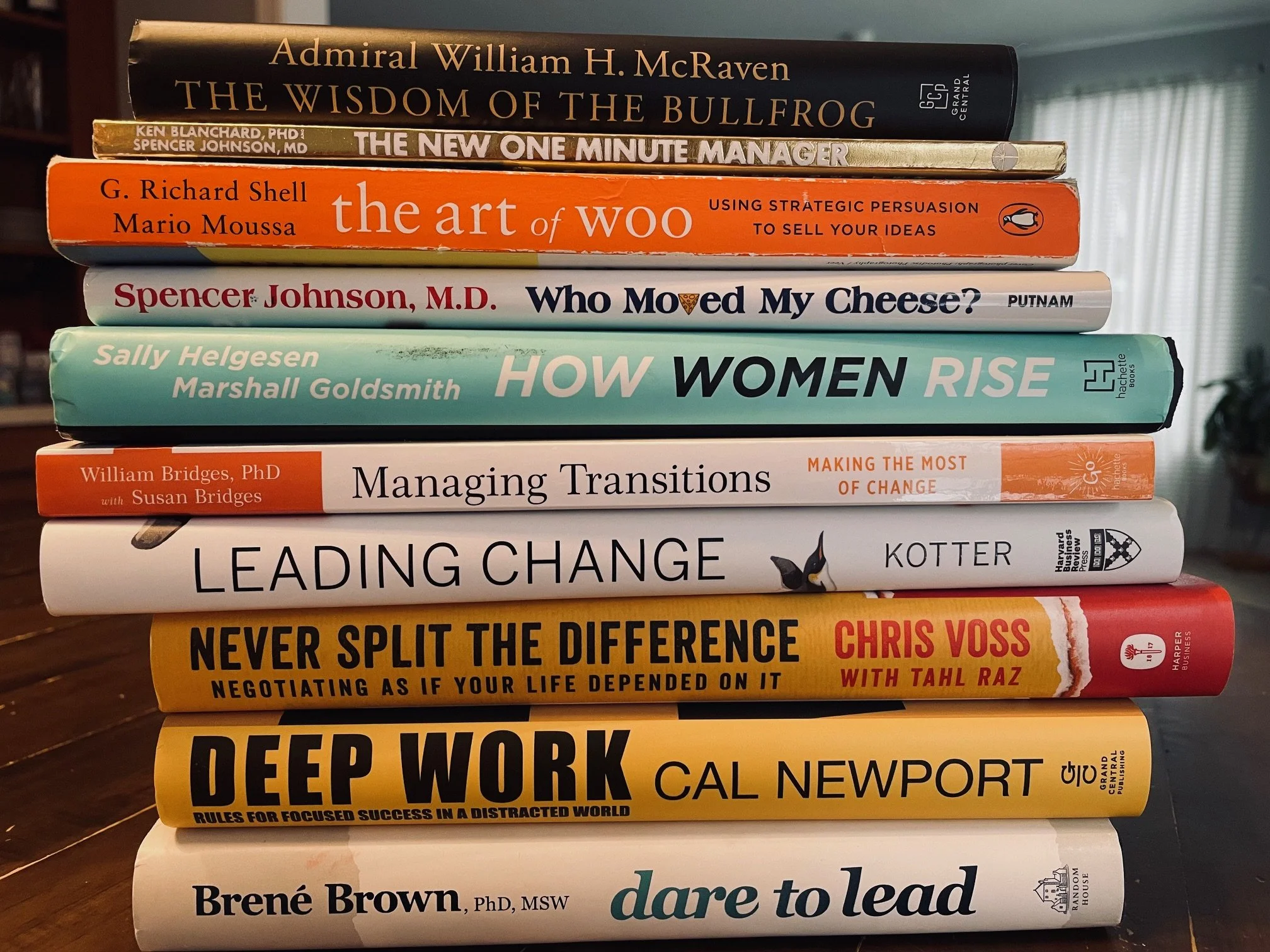
I read and think a lot about leadership.
But here’s a confession: I find most leadership books too dense to enjoy.
Many are 300 pages of concepts that could have been condensed into 120. Others are packed with research but light on practicality. And for the leaders I work with – physicians, nonprofit executives, founders, and emerging leaders, time is already scarce.
So when I recommend a leadership book, it needs to meet a high standard:
Clear and practical
Thought-provoking without being too academic
Readable in short bursts
Immediately applicable
Here are 11 leadership books I consistently recommend because they hit the mark.
1. Managing Transitions by William Bridges
A short, powerful look at the emotional side of change. Bridges distinguishes between change, which is external, and transition, which is internal. He outlines a clear three-stage framework: the Ending, the Neutral Zone, and the New Beginning. It’s a simple model that helps leaders normalize uncertainty and move forward with intention.
Best for leaders navigating change or identity shifts.
2. Leading Change by John P. Kotter
Kotter’s classic eight-step framework for organizational change is in a format that remains accessible and relevant. It’s structured, logical, and immediately useful.
I’ve personally used this framework to lead several system-level changes and have guided clients in applying it within their own organizations.
Best for leaders responsible for driving change involving multiple stakeholders.
3. The Five Dysfunctions of a Team by Patrick Lencioni
A leadership fable that is quick to read and easy to apply. Lencioni outlines five elements of effective teams: trust, healthy conflict, commitment, accountability, and results. The model offers a clear way to diagnose team challenges and prioritize action.
Best for leaders forming new teams or strengthening existing ones.
4. The Art of Woo by G. Richard Shell and Mario Moussa
This book focuses on how leaders can build influence without relying on positional authority. I return to it often because its PCAN framework for pitching ideas is simple, accessible, and immediately applicable. It provides a clear structure for gaining buy-in, whether advocating for organizational change or making the case for one’s own priorities. In my view, this is a must-read for every leader.
Best for leaders who need to build alignment, influence decisions, and advocate effectively.
5. Never Split the Difference by Chris Voss
Negotiation taught through stories from a former FBI hostage negotiator, but deeply applicable to everyday leadership. Voss translates tactical empathy and calibrated questions into tools you can use immediately in difficult conversations.
Best for leaders navigating conflict and high-stakes conversations.
6. Dare to Lead by Brené Brown
A modern guide to courageous leadership, vulnerability, and trust. Brown translates research into usable language and offers a framework for building psychological safety without sacrificing accountability.
Best for leaders working on building culture and trust.
7. How Women Rise by Sally Helgesen and Marshall Goldsmith
This book does an excellent job of naming the patterns that often hold women back in leadership, including perfectionism, overvaluing expertise, and reluctance to claim credit. Many women will recognize themselves in these descriptions. While it offers strategies for growth, its greatest strength is the clarity it brings to deep-rooted behaviors that are often subtle and well-intentioned.
Marshall Goldsmith’s What Got You Here Won’t Get You There explores parallel themes that tend to show up more often in men and is also worth reading.
Best for women ready to examine patterns that may be limiting their impact.
8. Deep Work by Cal Newport
Newport makes a compelling argument that the ability to focus deeply is becoming increasingly rare and increasingly valuable. For leaders, this is not just about productivity; it’s about creating space for strategic thinking rather than operating in constant reaction mode. Focused thinking time is not a luxury for leaders; it is essential.
Best for leaders who feel fragmented and overextended.
9. The Wisdom of the Bullfrog by Admiral William H. McRaven
Short chapters and hard-earned truths from a military leader with decades of experience, including service as a Navy SEAL. At its core, this is a book about values-driven leadership. McRaven consistently highlights principles of integrity, accountability, discipline, service, and personal responsibility. As he emphasizes, leadership is simple, though not easy. The principles are clear; living them consistently is the hard part.
Best for leaders who value clarity, discipline, and principle-centered leadership.
10. The New One Minute Manager by Ken Blanchard and Spencer Johnson
This book highlights clear goals, timely praise, and course correction as essential leadership skills, illustrated through a short and memorable story. It is remarkably effective for leaders who want to clarify expectations and strengthen feedback. What I especially appreciate is its brevity; it can be read in one to two hours, yet the takeaways are high-yield and immediately actionable.
Best for leaders who want to strengthen skills in setting expectations and giving feedback.
11. Who Moved My Cheese? by Spencer Johnson
A brief parable about navigating change through the story of two mice and two “little people” searching for cheese. Its simplicity is intentional. The metaphor brings clarity to very real reactions to change, including fear, denial, and resistance. Because it is short and accessible, it can create shared language quickly within a team.
Best for leaders and teams navigating disruption or significant change.
Why These Books Work
These books are not exhaustive treatises. They are practical, and they offer leaders language and shared frameworks. They create reference points for real conversations. Most importantly, each one is digestible.
As someone who works with leaders of all levels and high-performing professionals navigating growth, I have found these books consistently spark meaningful reflection without overwhelming already busy lives.
If you are building your leadership library, start here.
Which ones have you read? What would you add?
